
Trucking and Trailers
French Trucking Adapts to Shifting Markets
By Erin Kessler
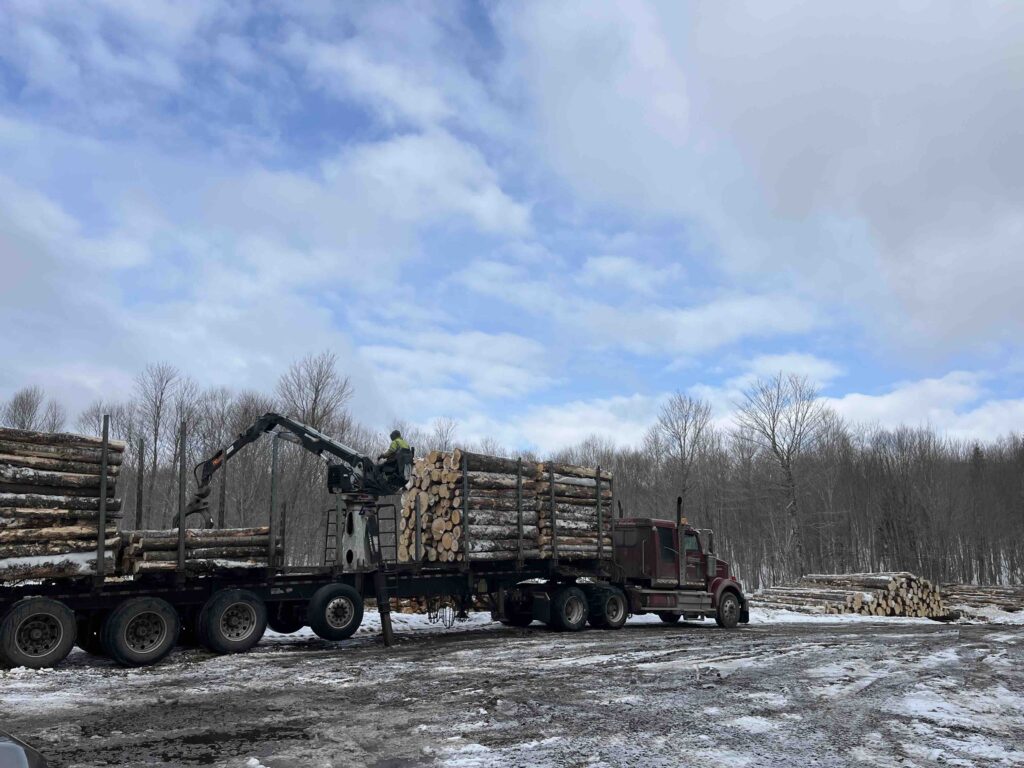
These days, large trucking companies that haul almost exclusively for the logging industry are few and far between in the Northeast and Lake States. Owner-operators have become the norm as overhead costs have skyrocketed, while larger log trucking companies have downsized or branched out into other specialties.
French Trucking, based in northern upstate New York in the town of Fine, has defied those trends. Herb French started in the business right out of high school, first hauling for his father, David. Following in his father’s footsteps in 1995, he bought his own truck, then another, growing his business with the help of his wife, Karen. For a while, French Trucking had only around four to five trucks on the road. One of their biggest markets back then was hauling pulpwood for companies like Champion International and Domtar Corporation. Both closed their paper mills in the region in the early 2000s. “We’ve dealt with mill closures our whole career,” says French.
Today, French Trucking hauls almost exclusively for the loggers. One of their biggest contracts is with MJ Lyndaker (Mike) Logging. Mike is one of four Lyndaker brothers, all of whom have their own logging operation cutting wood in and around the western side of Adirondack Park. French hauls for the whole Lyndaker family, but MJL is their biggest contract. “We haul for everybody, really, for Lyme Timber, the little jobbers, too… we do all across the board,” says French.
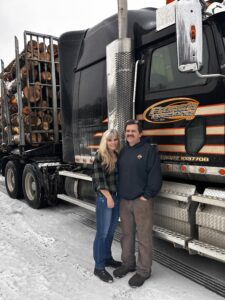
In 2010 the company expanded to nine trucks on the road, and in 2015 they bought a few more. “We just kept buying trucks,” says French. Now they have 17 log trucks and one dump truck, with 16 drivers hauling wood every day.
Finding those rugged individuals that can handle chains on winter roads, driving up and down narrow, steep slopes, and all kinds of weather conditions, is always a challenge. “You can’t just throw in like a freight driver,” says Karen French. “They haul heavy loads. They have to be able to do tire chains. They have to climb in and out of the woods. You have to have someone that knows what they’re doing if you’re sliding on ice. It’s a different skill set.” But the French’s consider themselves lucky. Thanks to their history and reputation, along with being known for taking really good care of their vehicles, they have – for the most part – been able hire and retain dependable log truck drivers. “We don’t go out and advertise, a lot of [finding drivers] is just word of mouth.”
Their 23-year-old son Ryan is also a versatile full-time truck driver for the company, while their older daughter Ashely works in the office when her two young boys are at school.
When it comes to tractor-trailer manufacturers, Herb French is not loyal to one particular brand. “It would be so much easier for me to be able to keep the service knowledge and parts on one particular truck versus three but I do have drivers who say ‘I got to have a Kenworth or I got to have a Peterbilt or I got to have a Western Star,’ so we try to accommodate them. Because, you know, they’re in them a lot of hours a day. They’re all beautiful trucks.”
In the wide and roomy garage at French Trucking, there is a large stock of parts, and each day the trucks are serviced by the three mechanics on staff. Most of the repairs and maintenance are done in-house, unless the truck is still under warranty, in which case it will be sent to the dealer for major issues. With the newer trucks and their emissions systems, French says that there’s always something going wrong. “There’s always a wire… the NOx sensors are always going bad. We take a lot of salt and stuff on the road, and it gets into all those wires. It’s madness. We were 10 hours yesterday just chasing one broken wire on the emissions side.” Keeping the trucks fully operational in order to keep drivers with a paycheck and the loggers’ wood moving is one of their biggest challenges. French reminisces about the days when he could buy a glider kit – a remanufactured engine, transmission, and rear axle, to put in a new shell truck to bypass the emissions systems. “The older trucks you’ll have some minor problems, exhaust problems, spring problems, bushings, and stuff like that. That stuff that we can fix relatively quick.”
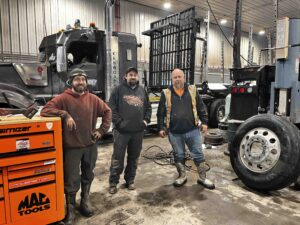
When his new trucks derate and can’t be treated on site, French will tow them back to the shop, bringing a spare truck along for the driver to switch into so he can continue on his run.
Along with his fleet of trucks, French has knuckleboom loader trailers, crib trailers, chip vans, lowboys, a dump truck, and flow boy trailers. In summer, when loggers are not as busy in the woods, they haul blacktop and asphalt for paving companies. “You gotta keep busy doing something in the summer,” says Karen French. In winter, it’s strictly log hauling and transporting heavy equipment for dealers in the area. “Ninety-five percent of our work is in the woods,” says French.
Dwindling markets – especially low-grade – have affected demand for hauling wood products. The closure of ReEnergy in 2023, a biomass plant in Fort Drum, NY, that supplied the US Army’s military base with 100% of their power, was a huge blow to the wood chips market. The closure was due to New York State’s decision that biomass would not be considered a renewable energy and, therefore ineligible for a tax credit. “We kind of had to offset that and we weren’t quite sure what we were going to do with all those trucks,” says French. But they have adapted and shifted and have developed other markets. Sylvamo in Ticonderoga and Finch Paper in Glens Falls are two their main runs, but they haul all over the state, up to 250 miles, going as far as Angelica in the southwestern tier. Although they have the capacity to go across state lines, French Trucking stays within NY state’s borders. Crossing state lines requires more permitting paperwork for Karen than she would like to deal with, and they stay busy enough in New York.
“We’ve been at it a long time so we kind of know what works and what doesn’t,” says French. “You have to love it… you can’t go into this industry, and you know, and have it be just your job.”
French Trucking, unquestionably, is a key player in the wood supply chain of NY state. Matt Farr, a log truck owner-operator and log buyer for Tupper Lake Pine mill says, “It would be impossible to do what I’m doing if it wasn’t for them and their trucks. You can call Herb at 8:00 at night and say, ‘Is there any way I can get a loader trailer in the morning and a rack trailer in the afternoon?’ and they’ll set it all up. They’re a staple in the industry. A very good family-run business.”
To subscribe to The Northern Logger, go to https://www.northernlogger.com/magazine-preview/