
Expo Issue
From “A Guy With a Chainsaw” to “Logger of the Year”
By Jen Weimer
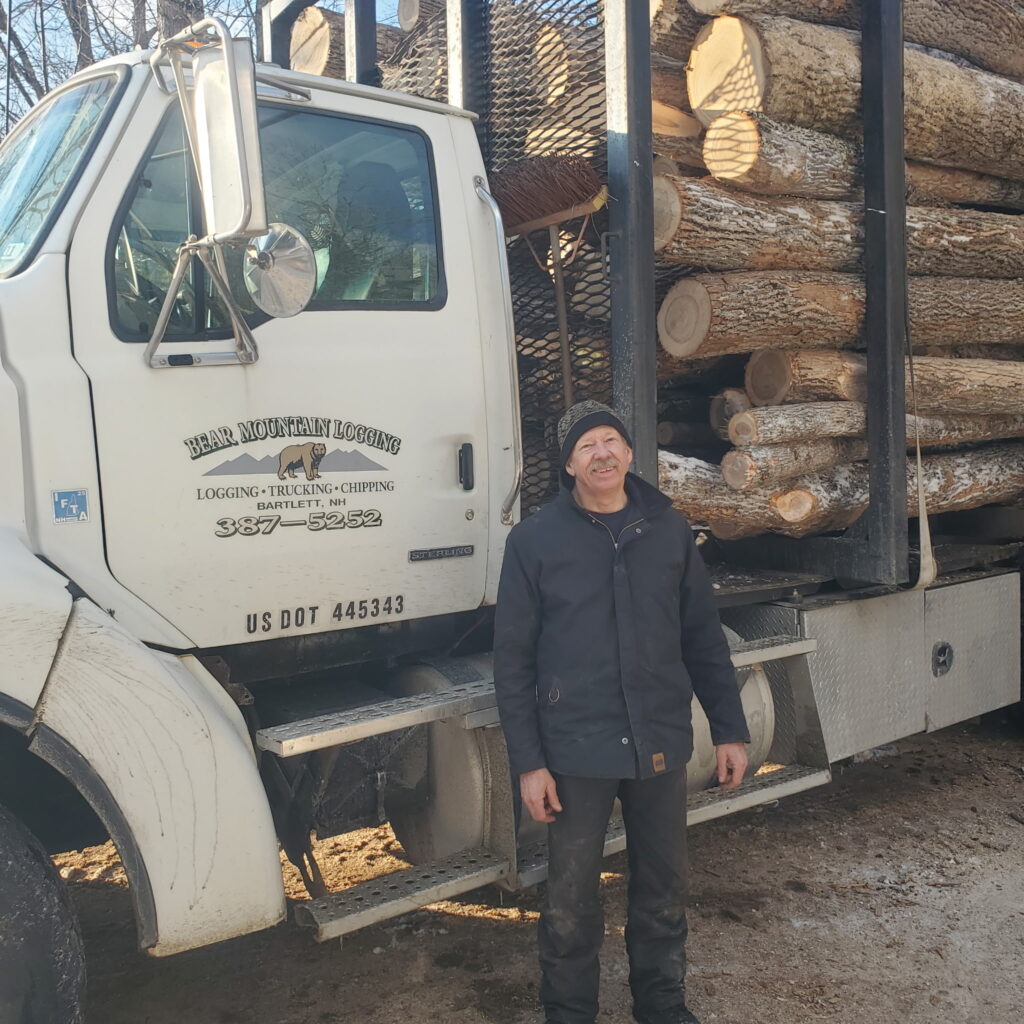
Don Ryder’s first date with a chainsaw was a bloody one. He was just a kid growing up just outside Boston when his dad dropped a saw from a willow tree and hit him in the face, chipping his front tooth. “I got blood all over my face,” Ryder recounted to The Northern Logger, “and a big smile.” Ryder’s father loved to burn wood. “We always had a fire,” he remembered, and firewood eventually became a way of life for him as well.
After high school, Ryder’s love of skiing drew him to New Hampshire, where he split time between weekend trips and working near Boston. He moved north full time in the early 1980s, just as heating fuel prices doubled and many switched to burning firewood. “That’s how it kind of started,” Ryder said. He began cutting, splitting and selling firewood, hauling downed trees with a snowmobile. “I’d get a half-ton pickup load of firewood and bring it down to Boston.”
What began as weekend runs turned into a viable business. With a bigger truck, he was hauling three-cord loads and making far more than local wages: “We were making $150 a cord, so we’d come back with $450,” Ryder continued. Local pay then was $2.75 to $3 an hour. He recalled thinking, “Wow, this is really cool.” From early on, he avoided debt. Banks wanted him to buy new equipment so they could repossess it, but he preferred stuff that he could fix up. Watching big contractors go under when the pulp price would drop and the fuel price would go up taught him to save money and buy with cash.
Today, Ryder owns Bear Mountain Logging in Bartlett and mostly works alone. He has occasional help from others, including his wife, who has also been a certified logger since 1999. Together, they were early adopters of safety and efficiency tools. “We were, I believe, the first crew to have two-way radios in our hard hats to communicate back and forth.” Ryder noted with some pride that radios now considered essential are something he’s been using for 25 years.
He learned the hard way that things can go wrong quickly. One incident that deeply changed his practices involved a winter job by a river, where he and his wife were clearing trees on an island. Although they were wearing full protective gear, a rolling oak log caused one of the branches to hit Ryder’s wife in the head and knock her “flat as a pancake.” Ryder remembers the chaos that followed when he realized their car was parked on the wrong side of the escape route, forcing him to cut trees to get his wife to the hospital. Even more alarming, he almost hit her with the skidder when she got out of the car, concussed and disoriented. He calls it “a good lesson” about vehicle placement and controlling who is in the work zone.
Ryder’s experiences have made him hyper-vigilant on job sites. He describes physically pulling a worker back from danger, warning, “those things are gonna go squirrely.” On another occasion he stopped a blasting operation because the escape truck was incorrectly placed, telling the crew, “If anything goes wrong, that’s the only way out of here.” Overall, Ryder stresses that accidents often come not from the obvious hazards but from overlooked details: “It’s not a lot of times the real dangerous stuff is what you obviously see, it’s what you’re not watching,” like escape routes, communication and situational awareness.
Ryder also sees safety risks from technology: “I see so many crews looking at their phones all the time and not paying attention.” While phones are useful in emergencies, the real problem is training people to “not use them unless they need them.” The logger recalls a serious incident involving a distracted worker who looked at his cell phone too much. A lodged pine snapped back and “threw a good-sized branch and hit this guy in the head,” knocking him out. The worker was airlifted to Portland with three broken vertebrae in his neck, requiring fusion surgery. Road safety worries Ryder as well. He avoids hauling on Fridays because “people are crazy … they’re all on their cell phones.” He now runs a dash camera because he says he’s often in a fully loaded log truck trying to avoid somebody who’s looking at their phone.
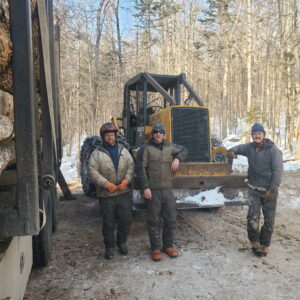
Another important focus in Ryder’s work is following best management practices (BMPs). He says New Hampshire BMPs, especially those around water, shape his daily decisions. He regularly uses portable bridge panels to keep equipment out of streams, noting that once they’re in place, “the problems are eliminated.” “If there’s even the slightest problem with water at all,” Ryder explains, “I’ll bring those bridges and just throw them down.” Overall, BMPs guide him toward keeping water clean and staying off wet ground.
To stay flexible, he’s diversified his work. One key practice is dealing with “junk wood” — material that’s not good for firewood — from tree service companies. Instead of burying it in stump dumps, which he believes “is only gonna make a problem for our kids,” he hauls it away, processes it and turns it into wood chips. Ryder stockpiles large logs and uses a big wood splitter to process them when other work slows: “It’ll split a 5-foot-diameter log,” which he then chips with his 24-inch chipper and sells as biomass. He supplies chips to Berlin and Whitefield and notes that market conditions matter: “The wood chip price is up to $40 a ton here right now,” making this approach both environmentally and economically practical. Ryder also does regional trucking and hauls materials from Maine to the Massachusetts border. His work includes specialized hauling, “whatever anybody wants to truck,” he said, like moving heavy split granite foundations for high-end stone projects.
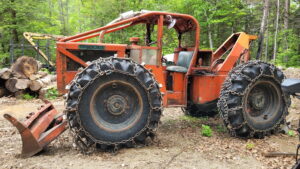
His equipment lineup is a mix of older, reliable machines and newer technology. At the core of his fleet is a 1964 Timberjack 225 cable skidder, which he values because “it’s small, it’s versatile,” and with “the best chains money will buy on it — it will go anywhere.” He’s used it on demanding terrain, noting that it’s been to the top of all the local ski mountains, including Cranmore, Wildcat and Attitash. Ryder enjoys the history tied to his equipment, describing how the same skidder that once helped build ski lifts in the 1960s later helped remove one: “I went up with the same machine and took the lift down. I thought that was pretty cool.”
Alongside older machines, Ryder has invested in newer tools that expand what he can do safely and efficiently. He
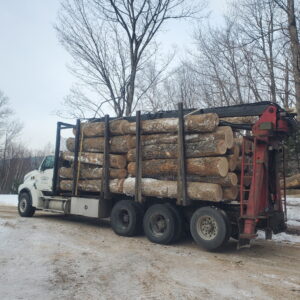
runs two excavators, one outfitted with a modern 12-inch shear that cuts and grabs and allows him to reach up to 24 feet to remove trees over houses. He calls it “awesome,” highlighting that it has air conditioning and heat, and adds, “my wife can drive it.” He also uses a mini excavator for small jobs, an older but well-maintained front-end loader for moving chips and material, and a tri-axle log truck with a trailer for hauling logs and equipment. The chip truck — a 10-wheeler with a 20-foot dumping cargo box — is a point of pride: “That’s an awesome rig,” he said, noting that he built it himself and a bunch of people have copied it. Ryder enjoys fixing and adapting equipment himself in his shop, which is heated by a wood boiler and radiant floors.
He emphasizes the importance of having a “full-blown shop” to repair stuff, calling it “really key” to keeping older and customized machines working. Ryder fondly recalls one of his customized machines, a homemade skidder built from a pickup truck, that won a race at the Fryeburg Fair in the 1980s. He beat major companies and recalls hearing the crowd roar when he realized “everybody else was still on the course!” The following year, homemade skidders were banned from the competition.
Ryder’s career philosophy has been to stay small, focusing on selective, careful work while letting larger operators manage big jobs, a balance that “kind of worked out.” He still heats exclusively with wood — “it’s a much better heat” — adding simply, “there’s plenty of it.” The seasoned logger sees opportunities ahead for small skilled loggers as insects, storms, and rising costs push big operators away from cleanup work. Looking at the future of logging in New Hampshire, he sees paperwork and regulation as major challenges for small operators. “Rules are so complex for the smaller operators to navigate,” he said, “while big companies can afford office staff.”
Reflecting on standout career moments, Ryder highlights multiple jobs at the U.S. Forest Service Bartlett Experimental Forest, including removing massive pine trees that were 3-foot-diameter on the stump to protect buildings. Initially told the trees were “sacred,” he warned, “they’re gonna blow over,” and was later hired to remove them all — about 80,000 board feet of timber. One proud moment came during that job when he coordinated logging around an active snowmobile trail instead of shutting it down. Crews stopped traffic only while trees were coming down, then reopened the trail. The Forest Service told them, “You guys are the bomb!”
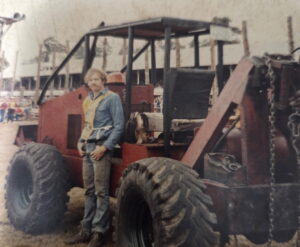
Despite slowing down, Ryder is still active, cutting oak on his own land that was killed by the recent spongy moth outbreak, hauling ash for crews in Jackson, fixing trailers and taking on unexpected projects, including refurbishing a trailer for the U.S. Ski Team. His advice to newcomers? “Go work for somebody else.” He warns against starting solo too soon — “don’t do it” — and urges people to learn how money flows, what happens when it rains for a week and your job is full of mud, and how there’s no paycheck when work stops. His own three-month layoff for back surgery underscored that reality. He emphasizes that growth can come from reinvesting earnings: “I’ve done it, with money that I’ve earned, instead of going through banks.” Careful record-keeping and integrity set him apart, so much so that a state forester once told him, “You’re the most organized logger I’ve seen in the state of New Hampshire.”
Don Ryder’s long journey from a guy with a chainsaw to a stable, respected logging business built without debt is admirable. It’s no surprise that the New Hampshire Timberland Owners Association recently awarded Ryder the honor of “Logger of the Year.”
To subscribe to The Northern Logger, go to https://www.northernlogger.com/magazine-preview/