
Innovation
Saving the Bartlett Experimental Forest
By Erin Kessler
On March 31, 2026, the USDA Forest Service announced a restructuring plan that would move its headquarters from Washington, DC, to Salt Lake City, Utah, and move regional offices to create a “state-based and service center model.” For the Northeast, that would mean a central office in Pennsylvania and for the Lake States, an office in Madison, Wisconsin.
The Forest Service also announced it would shut down research stations that serve 57 of the country’s 84 experimental forests and ranges. The announcement sent a shockwave throughout the vast community of forest workers and practitioners in the United States. Since then, there has been much discussion about what these closures would mean for Forest Service staff, researchers, Americans, and the science that informs decisions about how to manage our forests.
On their website the Forest Service states, “The Forest Service’s facilities footprint is extensive and significantly larger than can be supported under current congressional appropriations, which are declining for facilities.” The Forest Service also says they have proposed to close “select facilities at some experimental forests that are underutilized or vacant, and that those closures will not affect the ability to conduct research at these locations.”
Hubbard Brook Experimental Forest, a 7,854-acre forest in the White Mountains of New Hampshire, was upgraded from a list of facilities “to be evaluated” to a facility that would remain operational on May 11. Hubbard Brook is where acid rain was first discovered in North America in 1963. Anthea Lavallee, the executive director of the Hubbard Brook Research Foundation, credits the decision to keep Hubbard Brook open in large part to a bipartisan effort by democratic US Senators Jeanne Shaheen and Maggie Hassan and New Hampshire’s republican Governor Kelly Ayotte, who teamed up with Secretary of Agriculture Brook Rollins and other senior White House officials.
“It seemed like there was a very good chance that we were going to close as part of a future phase of the reorganization. It really was thanks to all of our community partners and forest industry management that rallied around us and stood up along with New Hampshire’s congressional delegation,” says Lavallee.
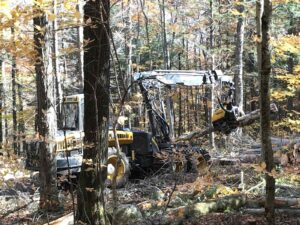
The fate of the 5,800-acre Bartlett Experimental Forest, also located in the White Mountains and considered Hubbard Brook’s sister site, remains in limbo. Bartlett’s facilities were originally designated to be closed, but on May 11 the Forest Service decided to reevaluate that decision. To date, Bartlett is still under evaluation. Lavallee says she’s been hearing in conversations in meetings that the next phase of the reorganization would probably happen after fire season.
Other experimental forest facilities and research stations that are under evaluation or slated to close include the Massabesic Experimental Forest in Maine, several research stations in Pennsylvania including Irvine near the Allegheny National Forest, the Evanston research station in Illinois, the Northern Forests Climate Hub headquartered in Houghton, Michigan, and many more.
What Is an Experimental Forest?
Experimental forests are long-term ecosystem study sites where large-scale experiments are conducted all across the country that are operated by the US Forest Service. “I think of them as pulse points for how the natural world is changing,” says Lavallee.
One example, she notes, is the Silas Little Experimental Forest in New Jersey, where researchers are looking at how to manage forests to protect them from wildfires, particularly in the Pine Barrens and forests in the Mid-Atlantic states.
The Bartlett, established in 1931, has research plots that have existed for over 90 years, where researchers have been able to document and show the results of good versus bad forestry. “The Bartlett Experimental Forest has been a proving ground for almost every forestry treatment ever plausibly proposed for managing northern hardwoods,” wrote David Dobbs in an article for Northern Woodlands in 2019.
A lot of the research that informs northern hardwood silviculture has come out of Bartlett. One example is how certain treatments affect the regeneration of different species of hardwoods. Over decades of research in Bartlett, researchers found that shelterwood cuts, which aim to maintain a mature canopy, often over-encourage beech, pushing out maple regeneration. They also found that single-tree selection also favors beech.
Another example is researchers’ experiments with patch cuts. In 1998, the late Research Forester William Leak published one of the first landscape-scale studies on how patch cuts worked. Leak inventoried harvest sites that had grown in small patch cuts created over 61 years in the forest. This research showed that compared to other harvest sites at Bartlett, patch cuts created a more diverse forest, regenerating more valuable timber, such as maple, ash, and birch. The patch cuts also created an environment where birds and other wildlife thrived, confirming what other researchers had found on a smaller scale.
Without this living laboratory, the Silvicultural Guide for Northern Hardwoods in the Northeast, published by the Forest Service Northern Research Station and referenced by foresters and students alike, would likely not exist.
What’s at Stake?
On the national level, Forest Service research and development would be greatly affected. The Forest Service excels at long-term place-based research, serving natural resource managers within the National Forest System as well as public and private lands in every state.
The reorganization would impact one-third of Forest Inventory and Analysis (FIA) staff and eliminate the R&D budget for 2027. The FIA program, which is based out of the regional offices that will close, is something that states and private industry rely on for data on forest trends.
“We believe one of the missions of the US Forest Service is research,” says Jasen Stock, Executive Director of the New Hampshire Timberland Owners Association (NHTOA). “They can do things on their property that would be very difficult for a private landowner to do. For a private landowner to set up a 90-year research plot, it’s just not practical, but that’s something the US Forest Service can do.”
For the Bartlett Experimental Forest, it would mean closing a laboratory, a bunkhouse, and a few other structures. The facilities house world-class research, yet the cost of maintaining those facilities has been reported as “minimal.” Although nobody lives at Bartlett, advocates for keeping the facilities open say that closing the bunkhouse, laboratory, and other buildings makes conducting research in the forest impractical.
The Dean of the College of Life Sciences and Agriculture at the University of New Hampshire, Dr. Anthony Davis, describes the on-the-ground research that is happening at Bartlett. “People use that facility. They don’t live up there and they are not working up there every day, but when they are gathering data, they have to analyze the data or prepare it to send it to a lab off-site, and you need a space to do that.” For example, there are researchers who are studying tree respiration rates and tree growth in the forest. In order to do that, they are outside taking samples every hour on the hour all through the night.
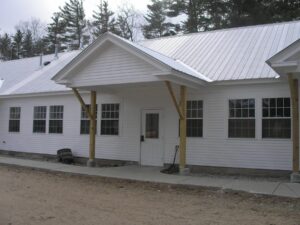
Stock adds, “So, you close the bunkhouse, and you close the lab and then you say, ‘Well, we’re going to continue the research.’ What’s the expectation there? Are these people going to sleep in their cars? Where do they take the sample? Do they take the sample and toss it in the trunk of their car? This notion that no one’s up there is totally wrong. It shows a lack of understanding of how those facilities are actually used and how they contribute to the research.”
The NHTOA sometimes hosts meetings and workshops at Bartlett. Stock says its role in education is very important. “There are scientists, researchers, and college groups from all over the Northeast that go there.”
For landowners and loggers, tours at Bartlett have also had an impact on the way they make decisions. Stock relates that one young logger told him that he “had a perception of what good management looked like.” Then he visited Bartlett and that changed. When landowners tell him that they want to manage for wildlife, the contractor has in mind to create different types of habitats, like patch cuts and things of that nature. A one-day tour of Bartlett gave him that knowledge and understanding. “It’s applied research that people buying wood and cutting wood can actually use today,” says Stock.
What Are the Impacts?
Regardless of your opinions on the restructuring, it will have a big impact – and is already showing signs of impact – on researchers and their ability to continue conducting long-term place-based science in experimental forests owned by the US government.
Retired Wildlife Biologist Mariko Yamasaki, who began working in the Bartlett Experimental Forest in the 1980s and worked closely with William Leak for 40 years, says the uncertainty of Bartlett’s future as a forest research location has already impacted other potential cooperators’ proposed plans to use it for their research.
UNH Dean Davis reports that newer faculty have been hesitant to work at Bartlett due to uncertainty over the past few years, and more established faculty are hesitant to expand projects or start something new without knowing if it can move forward. “There is no longer a partnership or network where we can discuss new experiments, how to implement them on the ground, and how to work collaboratively to answer diverse and overlapping questions,” he says. At least one UNH faculty member has shifted research activity away from Bartlett due to these concerns.
Yamasaki adds, “Current cooperating researchers who have used the lab and conference building in the past are not being allowed to use this building in support of their field work at this time.” She says that this impacts the many people who count on Bartlett for maintaining long-term vegetation data sets on an actively managed forest landscape. “This includes agency, industry, and consulting foresters, habitat biologists, ecologists, logging professionals, forest landowners, secondary wood processors, cooperative extension and university training, workshop, and tour attendees.”
Why Should You Care?
For timberland owners and wood products businesses, having a research forest that can study what their hardwood resource is going to look like years from now – as stressors change and as conditions change – helps inform decision-making. “Sawmills are making capital investments today with an expectation that timber is going to be rolling in for many years to come to pay down that investment. This research informs not only the scientists and people growing and managing forests, but it also provides feedback to people whose businesses and livelihoods rely on it,” says Stock.
“There’s the education piece but there’s also the very practical hands-on knowledge that comes out of this forest.” Some might think, ‘Good riddance; it’s just more government.’ But this is government that directly looks at the health of a resource that your business is reliant on, so you should care,” Stock emphasizes.
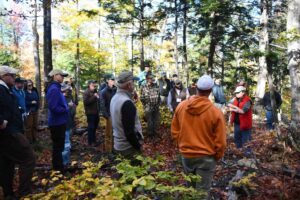
The future of the Bartlett Experimental Forest is uncertain, and the threat of losing vital research gathered over decades remains. The effort to keep Bartlett open continues through community partners, non-profits, and New Hampshire’s congressional delegation. On June 1, Congresswoman Maggie Goodlander visited Bartlett, meeting with over 50 forest experts, joined by Mariko Yamasaki.
Goodlander was able to meet with people in the forest industry at every stage of the supply chain and people who have been working in the forest since 1958. “It is hard from a distance to imagine how anyone would be orchestrating and executing a reorganization plan without actually coming here and talking to the people,” she said. “You’ve got to see it. You’ve got to understand the relationships that are complex… Because you just can’t allow these forests, which can’t be recreated, to be put on the chopping block.”
Correction: A previous version of this article states that one example of research coming out of Bartlett is how certain treatments affect the regeneration of sugar maple. The wording has been changed to different species of hardwoods. The printed version also states that the Bartlett Experimental Forest is 1,051 acres, but it is in fact 5,800 acres.
To subscribe to The Northern Logger, go to https://www.northernlogger.com/magazine-preview/